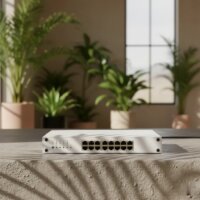
A 10Gb network switch, also known as a 10 Gigabit Ethernet (10GbE) switch, is a network device that enables data transfer rates of up to 10 gigabits per second (Gbps) between connected devices, which is ten times faster than standard 1 Gigabit Ethernet switches. This upgrade is essential for modern applications like 4K/8K video editing, large file backups, virtualization, and sophisticated home labs that exceed 1 Gigabit capabilities. These switches act as central traffic hubs, ensuring high-speed communication for servers, storage systems, and workstations, and are now accessible to prosumers and small businesses.

Why Upgrade to a 10Gb Network Switch?
If your current 1 Gigabit network is slow, a 10Gb network switch can significantly boost performance. The most evident benefit is a dramatic increase in data transfer speeds, allowing massive video files or server backups to complete in seconds rather than minutes. In real-world scenarios, 10GbE can deliver actual throughput of approximately 7-9 Gigabits, a substantial improvement over 1 Gigabit. For browse all network switches articles on this site.
Beyond raw speed, a 10Gb network switch offers several critical advantages. You will experience significantly lower latency, which is vital for real-time applications, gaming, and virtualized environments where every millisecond is crucial. This increased bandwidth also allows your network to support multiple users and high-bandwidth applications simultaneously without bottlenecks. For creative professionals, businesses with critical applications, or home lab enthusiasts, a 10Gb network switch enhances productivity and workflow efficiency. Investing in a 10Gb network switch today future-proofs your network, ensuring it can adapt to growing data demands and emerging technologies without frequent, costly upgrades.
Types of 10Gb Network Switches
10Gb network switches come in various configurations, each suited for different needs and environments. Understanding these types is crucial for making an informed decision.
Managed vs. Unmanaged 10Gb Switches
|
Our Picks for the Best Network Switch in 2026
As an Amazon Associate I earn from qualifying purchases.
|
||
| Num | Product | Action |
|---|---|---|
| 1 | TP-Link 8 Port Gigabit Ethernet Network Switch - Ethernet Splitter - Plug & Play - Fanless - Sturdy Metal w/ Shielded Ports - Traffic Optimization - Unmanaged - Lifetime Protection (TL-SG108) |

|
| 2 | UGREEN Ethernet Switch, 5 Port Gigabit Ethernet Splitter, Plug & Play, Wall Mount & Desktop Network Switch Hub, Unmanaged, Compact, with LED, Fanless Quiet, for Internet Cable, Laptop, Router, NAS |
|
| 3 | TP-Link 5-Port Gigabit Ethernet Easy Smart Switch- Plug and Play - Desktop - Sturdy Metal w/Shielded Ports - Limited Lifetime Replacement (TL-SG105E), Black… |
|
| 4 | NETGEAR 8-Port Gigabit Ethernet Unmanaged Essentials Switch (GS308) - Home Network Hub, Office Ethernet Splitter, Plug-and-Play, Silent Operation, Desktop or Wall Mount |
|
| 5 | TP-Link 24 Port Gigabit Ethernet Switch Desktop/ Rackmount Plug & Play Shielded Ports Sturdy Metal Fanless Quiet Traffic Optimization Unmanaged (TL-SG1024S) |
|
| 6 | TP-Link TL-SG105, 5 Port Gigabit Unmanaged Ethernet Switch, Network Hub, Ethernet Splitter, Plug & Play, Fanless Metal Design, Shielded Ports, Traffic Optimization |
|
| 7 | TP-Link TL-SG105S-M2 - 5-Port Multi-Gigabit 2.5G Ethernet Switch - Unmanaged Network Switch - Ethernet Splitter - Plug & Play - Desktop/Wall Mount - Silent Operation |
|
| 8 | BrosTrend 2.5Gb Switch, 8 Port Network Switch 2.5 Gigabit, Unmanaged Ethernet Switch for Game Console, NAS, PC, Computer Networking Switch Plug & Play Fanless, Desktop Wall Mount, Lifetime Protection |
|
| 9 | UGREEN 16 Port Gigabit Switch, Plug & Play Ethernt Switch, Standard/VLAN Mode, Unmanaged, Sturdy Metal, Fanless Quiet, Desktop & Wall Mount Network LAN Splitter Hub for Laptop, Printer, NAS, Router |
|
| 10 | TP-Link Litewave 5 Port Gigabit Ethernet Switch - Desktop Ethernet Splitter - Unshielded Network Switch - Plug & Play - Fanless Quiet - Unmanaged (LS1005G) |
|
Unmanaged 10Gb switches are plug-and-play, requiring no configuration. They are generally more affordable and suitable for basic networks, home users, or small offices with minimal customization needs.
Managed 10Gb switches, conversely, offer extensive network control. They allow configuration of individual ports, traffic prioritization (Quality of Service – QoS), Virtual Local Area Networks (VLANs) for network segmentation, advanced security features (like ACLs and 802.1X authentication), and performance monitoring via protocols like SNMP. While more expensive and requiring some networking expertise, managed switches are essential for complex networks, businesses needing granular control, enhanced security, and optimized performance. Many modern managed switches feature user-friendly web interfaces, simplifying advanced configuration.
PoE (Power over Ethernet) 10Gb Switches
PoE 10Gb switches deliver both data and electrical power over a single Ethernet cable, which is highly beneficial for powering devices such as Wi-Fi access points, IP cameras, VoIP phones, and other IoT devices without separate power outlets. If you plan to deploy such devices, a PoE-enabled 10Gb network switch simplifies cabling and installation. Always ensure the switch provides sufficient PoE power budget (measured in watts) for all connected devices.
Stackable 10Gb Switches
Stackable switches allow multiple physical switches to operate as a single logical unit, simplifying management, increasing port density, and enhancing network resilience. While less common for typical home users, stackable 10Gb network switches are highly beneficial for growing businesses and enterprise environments that require scalability and high availability without the complexity of managing many individual switches.
SFP+ vs. RJ45 (Copper) 10Gb Ports
10Gb network switches primarily use two types of ports:
- RJ45 (10GBASE-T): These are standard Ethernet ports that use copper cabling (Cat6a or Cat7 for full 10Gb speeds, or Cat5e/Cat6 for shorter distances and multi-gig speeds like 2.5Gbps or 5Gbps). The main advantage is compatibility with existing copper infrastructure, potentially reducing re-cabling costs. However, 10GBASE-T transceivers can consume more power and generate more heat.
- SFP+: These ports utilize small form-factor pluggable transceivers, accommodating fiber optic cables for longer distances or Direct Attach Cables (DACs) for shorter, cost-effective connections. SFP+ typically offers lower latency and can be more power-efficient. For home labs or server rooms with short runs, DACs are an economical way to achieve 10Gb speeds.
Your choice depends on existing cabling, required distances, and budget. Some switches offer a mix of both port types for maximum flexibility.
Choosing the Right 10Gb Network Switch for Your Needs
Selecting the ideal 10Gb network switch can be straightforward by focusing on your specific requirements.
First, assess your current and anticipated number of 10Gb-capable devices, including servers, NAS units, high-performance workstations, and other devices that will benefit from 10Gb connectivity. Switches are available with various port counts, from compact 4- or 8-port desktop models to larger 24- or 48-port rackmount units. It is advisable to include a few extra ports for future expansion.
Consider the switching capacity (or backplane bandwidth), which indicates the maximum data the switch can handle simultaneously without slowdowns. For optimal performance, look for a non-blocking architecture where the switching capacity is equal to or greater than the sum of all ports’ bidirectional speeds. For example, an 8-port 10Gb switch should ideally have a switching capacity of 160 Gbps (8 ports * 10 Gbps * 2 for bidirectional).
Latency is another critical factor, especially for real-time applications like virtualization or high-frequency trading. Aim for switches with a store-and-forward latency below 2.5 microseconds.
Your budget will naturally influence your choice. Managed and PoE-enabled switches are generally more expensive than their unmanaged, non-PoE counterparts. However, the long-term benefits of control, security, and power delivery often justify the initial cost for many users. For home labs, refurbished enterprise-grade SFP+ switches can offer excellent value.
Also, consider the physical form factor. Determine if it will sit on a desktop or if you need a rackmount unit for a server cabinet. Ensure compatibility with your existing network equipment, including routers, firewalls, and Network Interface Cards (NICs) in your computers. While most modern 10Gb switches are backward compatible with Gigabit Ethernet, it is always wise to double-check. Finally, consider scalability. If rapid growth is anticipated, a switch that supports stacking or has modular expansion slots can be a wise long-term investment.
Basic Setup and Configuration of a 10Gb Network Switch
Setting up your 10Gb network switch is a straightforward process.
- Install 10GbE Network Interface Cards (NICs): Your computers require 10GbE-capable NICs to communicate at 10Gbps. These typically plug into a PCIe slot on your motherboard. Power down your computer, install the card, then boot up and install the necessary drivers, usually from the manufacturer’s website.
- Place and Power the Switch: Select a suitable location for your 10Gb network switch, ensuring adequate ventilation, as 10GbE equipment can generate more heat than 1GbE. Connect the power cable and turn it on.
- Connect Your Devices with the Right Cables: Use appropriate cabling (Cat6a or Cat7 for RJ45, or fiber optic/DACs for SFP+) from your devices to the 10Gb network switch. Ensure cable lengths are within specifications for optimal performance. Verify connectivity by checking link lights on the switch and your NICs.
- Initial Configuration (for Managed Switches): For managed 10Gb network switches, access the management interface, typically via a web browser using a default IP address. Here, you will set a static IP address for the switch, update firmware, and configure features like VLANs, QoS, and Jumbo Frames (setting MTU to 9000 bytes can improve performance for large file transfers). Unmanaged switches are plug-and-play.
- Test Your Connection: Verify your 10Gb network by transferring large files between two 10Gb-connected devices or using network performance tools like iPerf3 to confirm actual throughput.
Common Issues and Troubleshooting with 10Gb Network Switches
Even with careful planning, you might encounter issues. Here are common problems and their solutions:
If you are not achieving full 10Gb speeds, first check all components in the chain:
- NICs: Ensure both your source and destination devices have functional 10GbE NICs and up-to-date drivers.
- Cabling: Verify you are using the correct cable type and quality (e.g., Cat6a/Cat7 for copper) for your distances. Damaged or poor-quality cables can severely limit speed.
- Storage Speed: Slow storage can bottleneck even the fastest network. Traditional Hard Disk Drives (HDDs) have maximum read/write speeds far below 10Gbps. To fully utilize 10GbE, you will need SSDs or NVMe drives, often in a RAID configuration.
- CPU/RAM: Older or underpowered CPUs and insufficient RAM can sometimes struggle with extremely high network throughput.
- Configuration (Managed Switches): Double-check your switch’s configuration, including Jumbo Frames, flow control, and any QoS settings that might inadvertently limit bandwidth.
While most 10GbE ports are backward compatible and will auto-negotiate to slower speeds (like 1Gbps, 2.5Gbps, or 5Gbps), occasional compatibility quirks with specific devices or NICs can occur. Ensure your NIC drivers are updated and check the switch’s documentation for any known compatibility notes.
If you experience network congestion even with a 10Gb switch, that if your Internet connection is slower than 10Gbps, your external traffic will still be limited by your ISP’s speed. A 10Gb network switch primarily enhances internal network communication. However, a fast internal network prevents local bottlenecks when multiple users access external resources simultaneously. Also, ensure your router and any upstream devices do not become bottlenecks; if your router only has 1GbE ports and you connect your 10Gb switch to it, your entire network’s external traffic will be capped at 1Gbps.
“Upgrading to a 10 Gigabit network switch isn’t just about raw speed; it’s about unlocking the full potential of your data. From accelerating massive file transfers to seamlessly running multiple virtual machines, a well-chosen 10Gb switch transforms your network into a powerhouse, making you wonder how you ever managed without it.” – Ethan Vance, Lead Network Architect at VGLan.com
Frequently Asked Questions (FAQ)
Q: Is a 10Gb network switch worth it for a home user? A: Absolutely! While not every home needs one, if you work with large files (video editing, photography), have a home server or NAS, enjoy high-bandwidth gaming, or run virtual machines, a 10Gb network switch dramatically improves performance, reduces wait times, and provides a smoother overall experience.
Q: Can I use my existing Cat5e or Cat6 cables with a 10Gb switch? A: It depends. For full 10Gbps speeds over copper, Cat6a or Cat7 cables are generally required. However, many newer 10GBASE-T devices support multi-gig speeds (2.5Gbps or 5Gbps) over shorter runs of Cat5e or Cat6, offering a significant upgrade even without re-cabling.
Q: What is SFP+ and how is it different from RJ45? A: SFP+ is a type of port that uses pluggable transceivers, typically for fiber optic cables or Direct Attach Cables (DACs). RJ45 ports use standard Ethernet cables. SFP+ is often preferred for longer distances, lower latency, and can be more cost-effective for short connections with DACs in data center or home lab environments.
Q: Do I need 10Gb Internet to benefit from a 10Gb network switch? A: No. A 10Gb network switch primarily boosts your internal network speeds (device-to-device communication within your local network). While it won’t directly make your internet faster if your ISP provides less than 10Gbps, it will prevent your internal network from becoming a bottleneck when multiple devices access the internet or transfer large files locally.
Q: What are VLANs, and why would I use them with a managed 10Gb switch? A: VLANs (Virtual Local Area Networks) allow you to logically segment your network into separate broadcast domains, even if devices are connected to the same physical switch. This can improve security, optimize network performance by reducing broadcast traffic, and simplify management for different groups of devices (e.g., separating guest Wi-Fi from your main network).
Conclusion
Upgrading to a 10Gb network switch is an investment in efficiency, productivity, and a smoother digital life. Whether you are a creative professional rendering 8K video, a small business managing critical data, or a home enthusiast building the ultimate lab, a 10Gb network switch provides the robust, high-speed backbone you need. By understanding the available types, carefully selecting based on your needs, and knowing how to set it up, you can unlock incredible network performance that will improve your daily operations and make frustrating slowdowns a distant memory. Empower your network with a 10Gb network switch and experience the future of connectivity today. VGLan.com is always here to help you navigate these powerful technologies and build a network that truly works for you.
Frequently Asked Questions
Is a 10Gb network switch worth it for a home user?
Yes, a 10Gb network switch is worth it for home users who work with large files, have a home server or NAS, enjoy high-bandwidth gaming, or run virtual machines. It dramatically improves performance, reduces wait times, and provides a smoother overall experience for these demanding tasks.
Can I use my existing Cat5e or Cat6 cables with a 10Gb switch?
For full 10Gbps speeds over copper, Cat6a or Cat7 cables are generally required. However, many newer 10GBASE-T devices support multi-gig speeds (2.5Gbps or 5Gbps) over shorter runs of Cat5e or Cat6, offering a significant upgrade even without re-cabling.
What is SFP+ and how is it different from RJ45?
SFP+ is a port type that uses pluggable transceivers, typically for fiber optic cables or Direct Attach Cables (DACs), offering lower latency and greater power efficiency. RJ45 ports use standard Ethernet cables. SFP+ is often preferred for longer distances or cost-effective short connections in data center or home lab environments.
Do I need 10Gb Internet to benefit from a 10Gb network switch?
No, a 10Gb network switch primarily boosts your internal network speeds for device-to-device communication within your local network. While it won't directly make your internet faster if your ISP provides less than 10Gbps, it prevents your internal network from becoming a bottleneck when multiple devices access the internet or transfer large files locally.
What are VLANs, and why would I use them with a managed 10Gb switch?
VLANs (Virtual Local Area Networks) allow you to logically segment your network into separate broadcast domains, even if devices are connected to the same physical switch. This improves security, optimizes network performance by reducing broadcast traffic, and simplifies management for different groups of devices, such as separating guest Wi-Fi from your main network.
Basic Setup and Configuration of a 10Gb Network Switch
This guide outlines the basic steps to install and configure a 10Gb network switch for optimal performance in your home or business network.
Ensure your computers have 10GbE-capable NICs installed in a PCIe slot. Power down your computer, install the card, then boot up and install the necessary drivers, typically found on the manufacturer's website.
Choose a suitable location for your 10Gb network switch with adequate ventilation, as 10GbE equipment can generate more heat. Connect the power cable and turn on the switch.
Run appropriate cabling (Cat6a or Cat7 for RJ45, or fiber optic/DACs for SFP+) from your devices to the 10Gb network switch. Verify connectivity by checking the link lights on both the switch and your NICs.
For managed switches, access the management interface via a web browser using the default IP address. Set a static IP, update firmware, and configure features like VLANs, QoS, and Jumbo Frames (MTU 9000 bytes) for optimal performance. Unmanaged switches are plug-and-play.
Verify your 10Gb network is working by transferring large files between two 10Gb-connected devices or using network performance tools like iPerf3. This confirms the actual throughput you are achieving.
Get our weekly buyer guide
Practical specs, not advice. Unsubscribe anytime.
I bought a 10Gb switch hoping to speed up my large file transfers for my photography business. While the speeds are definitely better than my old 1 Gigabit setup, I found the setup process a bit more complicated than I anticipated. The documentation wasn’t super clear for a beginner, and I had to do some extra research to get everything configured correctly. It works well now, but the initial hurdle was a bit frustrating.
As someone who does a lot of 4K video editing, I can’t believe I waited this long to get a 10 Gigabit Ethernet switch. My workflow is so much smoother now, especially when accessing project files from my network-attached storage. No more frustrating lag or stuttering. This really is essential for anyone dealing with high-bandwidth applications.
I finally pulled the trigger on a 10GbE switch for my home lab, and wow, what a difference! Transferring large VM images used to take forever, but now it’s practically instant. I’m running multiple virtual machines and a NAS, and everything feels so much snappier. Definitely worth the investment if you’re doing anything serious with your network.
Upgraded to a 10Gb switch for my small business, mainly for faster backups to our server. It’s been a huge improvement, especially with the large video files we handle daily. My only minor complaint is that the unit runs a bit warmer than I expected, but it’s in a well-ventilated area so it’s not a dealbreaker. Speeds are fantastic.