Best Netgear Network Switch for Enterprise Environments
The Netgear M4300 series, specifically the M4300-96X, is the best Netgear network switch for enterprise environments due to its modular design, high port density, and advanced Layer 3 features. This series offers exceptional flexibility and scalability, which are crucial for evolving business network demands. Enterprises require robust, reliable, and secure networking infrastructure to support critical operations and data flow. Netgear provides a range of switches designed to meet these stringent requirements, offering various port configurations, Power over Ethernet (PoE) capabilities, and advanced management options. Selecting the right switch involves evaluating factors such as network size, traffic volume, security needs, and future expansion plans.
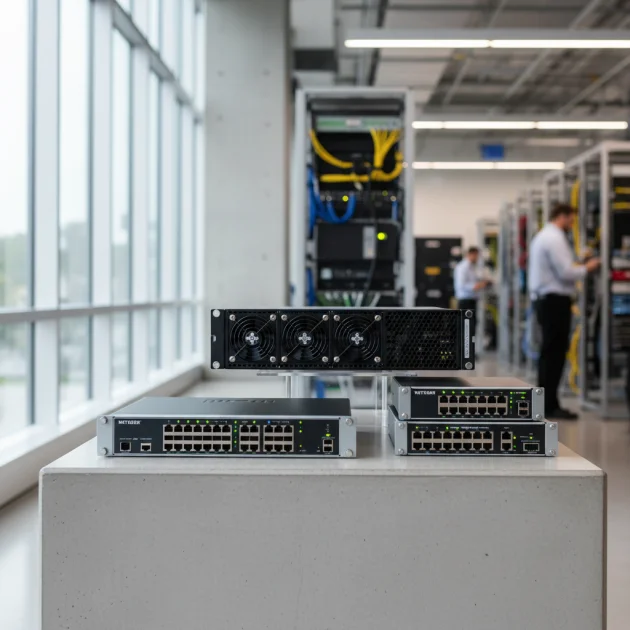
Quick Comparison
| Model | Key Feature | Port Configuration | Layer | PoE+ Budget |
|---|---|---|---|---|
| Netgear M4300-96X | Modular, High Density | Up to 96x 10G/40G | Layer 3 | N/A (Modular PSUs) |
| Netgear M4300-28G | Cost-Effective 10G Uplinks | 24x 1G, 4x 10G | Layer 3 | 390W |
| Netgear M4500-48XF | High-Performance 100G | 48x 10G, 8x 100G | Layer 3 | N/A |
What Enterprise Needs from a Network Switch
Enterprise networks demand switches that provide high performance, robust security, and seamless scalability. High throughput is essential to handle large volumes of data traffic without bottlenecks, supporting applications like VoIP, video conferencing, and cloud services. Reliability is paramount; switches must operate continuously with minimal downtime to ensure business continuity. Advanced security features, including access control lists (ACLs), port security, and 802.1X authentication, protect sensitive data from unauthorized access and cyber threats. Enterprises also require switches with comprehensive management capabilities, such as SNMP, RMON, and a user-friendly web interface, to simplify network configuration and monitoring. Power over Ethernet (PoE/PoE+) support is often critical for powering IP cameras, wireless access points, and other network devices, reducing cabling complexity and deployment costs. Furthermore, Layer 3 routing capabilities are vital for segmenting large networks, improving efficiency, and managing inter-VLAN routing effectively. The ability to stack switches provides simplified management and increased redundancy, ensuring network resilience. Future-proofing through support for higher speeds like 10 Gigabit Ethernet and beyond is also a key consideration for long-term investment protection.
Detailed Reviews
Netgear M4300-96X
The Netgear M4300-96X is a modular, high-density 10 Gigabit and 40 Gigabit Ethernet switch designed for large enterprise deployments. Its unique modular design allows for flexible port configurations, supporting up to 96 ports of 10G or 24 ports of 40G, or a mix of both, making it highly adaptable to specific network requirements. This switch offers a full Layer 3 feature set, including static, RIP, OSPF, VRRP, and PIM routing, ensuring robust network segmentation and efficient traffic management. The M4300-96X supports hitless failover for power supplies and fans, enhancing network reliability and uptime. Its non-blocking architecture guarantees wire-speed performance across all ports, crucial for demanding enterprise applications. The switch also features advanced security options like ACLs, 802.1X, and DHCP snooping. Management is simplified through a command-line interface (CLI), web GUI, and SNMP. This model is ideal for core and aggregation layers in large enterprise networks, data centers, and campus environments requiring high performance and scalability.
Netgear M4300-28G
The Netgear M4300-28G is a versatile Layer 3 managed switch, offering 24 Gigabit Ethernet ports and 4 dedicated 10 Gigabit SFP+ uplinks. This configuration provides excellent flexibility for connecting high-bandwidth devices or for network aggregation. It supports a comprehensive suite of Layer 3 routing protocols, including static, RIP, OSPF, and VRRP, enabling efficient inter-VLAN routing and network segmentation. The M4300-28G is available with Power over Ethernet Plus (PoE+) capabilities, delivering up to 30W per port with a total power budget of 390W, suitable for powering numerous IP phones, wireless access points, and surveillance cameras. Its stacking capabilities allow for up to 8 switches to be managed as a single unit, simplifying administration and increasing network resilience. The switch features advanced security features such as ACLs, port security, and DHCP snooping. With its robust feature set and competitive price point, the M4300-28G is an excellent choice for medium-sized enterprises or as an access layer switch in larger organizations.
Netgear M4500-48XF
The Netgear M4500-48XF is a high-performance, ultra-low latency Layer 3 switch designed for demanding enterprise and data center applications. It features 48 ports of 10 Gigabit SFP+ and 8 ports of 100 Gigabit QSFP28, providing immense bandwidth for high-speed connectivity. This switch is optimized for AV over IP deployments, offering specific features like IGMP Plus for seamless multicast traffic management. The M4500-48XF supports advanced Layer 3 routing protocols, including BGP, OSPF, and PIM, making it suitable for complex network architectures. Its non-blocking architecture ensures wire-speed performance across all ports, critical for applications requiring minimal latency. The switch also includes comprehensive security features and advanced QoS capabilities to prioritize critical traffic. Management options include a CLI, web GUI, and SNMP. The M4500-48XF is an ideal solution for enterprises requiring extreme performance, high port density, and future-proof connectivity for their core network or data center infrastructure.
Routine Fit
Netgear network switches seamlessly integrate into various enterprise routines, enhancing productivity and operational efficiency. For daily office operations, switches like the M4300-28G provide reliable connectivity for workstations, IP phones, and wireless access points, ensuring smooth communication and data access. In data centers, the M4300-96X or M4500-48XF handle high-volume traffic from servers and storage arrays, supporting critical applications and virtualization environments. For security and surveillance, PoE-enabled switches power IP cameras, simplifying deployment and management. The advanced Layer 3 features facilitate network segmentation, isolating different departments or traffic types, which improves security and performance. Remote management capabilities allow IT teams to monitor and configure switches from anywhere, reducing response times and maintaining network health. Netgear switches are designed for continuous operation, minimizing downtime and supporting business continuity across all enterprise routines.
FAQs
What is the difference between Layer 2 and Layer 3 switches?
Layer 2 switches operate at the data link layer of the OSI model, forwarding data based on MAC addresses. They are primarily used for connecting devices within the same local area network (LAN) segment. Layer 3 switches, on the other hand, operate at the network layer and can perform routing functions based on IP addresses. This allows them to forward traffic between different VLANs or subnets, effectively acting as a router. Layer 3 switches are essential for larger enterprise networks that require network segmentation, inter-VLAN routing, and more advanced traffic management capabilities to optimize performance and security.
Do Netgear enterprise switches support Power over Ethernet (PoE)?
Yes, many Netgear enterprise switches offer Power over Ethernet (PoE) and Power over Ethernet Plus (PoE+) capabilities. PoE allows network cables to carry electrical power to powered devices like IP phones, wireless access points, and surveillance cameras, in addition to data. PoE+ (802.3at) provides more power per port (up to 30W) compared to standard PoE (802.3af, up to 15.4W), supporting a wider range of power-hungry devices. This feature simplifies network deployments by eliminating the need for separate power outlets for each device, reducing cabling complexity and installation costs in enterprise environments.
Can Netgear enterprise switches be stacked?
Yes, many Netgear enterprise-grade switches, particularly within the M4300 and M4500 series, support stacking. Stacking allows multiple physical switches to be managed as a single logical unit, simplifying network administration and configuration. This feature also provides increased redundancy and bandwidth, as traffic can be distributed across the stacked units. If one switch in the stack fails, the others can continue to operate, ensuring network resilience. Stacking is a valuable feature for enterprises looking to scale their network infrastructure while maintaining ease of management and high availability.
What security features do Netgear enterprise switches offer?
Netgear enterprise switches provide a comprehensive suite of security features to protect network assets and data. These include Access Control Lists (ACLs) for granular traffic filtering, 802.1X port-based authentication to control network access, and DHCP snooping to prevent rogue DHCP servers. Other features often include IP-MAC binding, port security to limit the number of MAC addresses per port, and storm control to prevent broadcast storms. These security measures are crucial for enterprises to safeguard against unauthorized access, data breaches, and various network attacks, ensuring a secure and compliant network environment.
How do I manage Netgear enterprise switches?
Netgear enterprise switches offer multiple management options to suit different IT preferences and skill levels. Most switches can be managed via a Command Line Interface (CLI) for advanced users, providing detailed control and scripting capabilities. A user-friendly web-based Graphical User Interface (GUI) is also available for intuitive configuration and monitoring. Additionally, switches support Simple Network Management Protocol (SNMP), allowing integration with network management systems for centralized monitoring and alerts. Some models also offer cloud management capabilities for remote access and simplified deployment across multiple sites, enhancing flexibility for enterprise IT teams.
Verdict
For enterprises seeking the best Netgear network switch, the M4300 series, particularly the M4300-96X, offers an unparalleled combination of modularity, high performance, and advanced Layer 3 features. Its ability to scale with evolving business needs, coupled with robust security and reliability, makes it an ideal choice for core and aggregation layers. For medium-sized businesses or access layer deployments, the M4300-28G provides excellent value with its 10 Gigabit uplinks and PoE+ capabilities. For ultra-high performance and specialized applications like AV over IP, the M4500-48XF stands out. Ultimately, Netgear provides a strong portfolio of enterprise-grade switches designed to meet the diverse and demanding requirements of modern business networks, ensuring reliable, secure, and scalable connectivity.
Frequently Asked Questions
What is the difference between Layer 2 and Layer 3 network switches?
Layer 2 switches forward data based on MAC addresses within a single LAN segment, while Layer 3 switches perform routing functions based on IP addresses, allowing them to forward traffic between different VLANs or subnets. Layer 3 switches are essential for larger enterprise networks requiring segmentation and advanced traffic management.
Do Netgear enterprise switches support Power over Ethernet (PoE)?
Yes, many Netgear enterprise switches offer PoE and PoE+ capabilities, allowing network cables to carry electrical power to devices like IP phones and wireless access points. PoE+ (802.3at) provides up to 30W per port, simplifying deployments by eliminating the need for separate power outlets and reducing cabling complexity.
Can Netgear enterprise-grade switches be stacked for better management?
Yes, many Netgear enterprise-grade switches, particularly within the M4300 and M4500 series, support stacking. Stacking allows multiple physical switches to be managed as a single logical unit, simplifying administration and increasing redundancy and bandwidth. This feature ensures network resilience and scalability for growing infrastructures.
What security features are included in Netgear enterprise switches?
Netgear enterprise switches provide comprehensive security features such as Access Control Lists (ACLs) for traffic filtering, 802.1X port-based authentication, and DHCP snooping to prevent rogue DHCP servers. Other features include IP-MAC binding and port security, crucial for safeguarding against unauthorized access and network attacks.
How can I manage Netgear enterprise network switches?
Netgear enterprise switches offer multiple management options, including a Command Line Interface (CLI) for advanced users and a user-friendly web-based Graphical User Interface (GUI). They also support Simple Network Management Protocol (SNMP) for integration with network management systems, and some models feature cloud management for remote access.
Get our weekly buyer guide
Practical specs, not advice. Unsubscribe anytime.
I was looking for a switch that could handle a lot of traffic volume for our small business. While the Netgear M4300 series is powerful, I found the price point a bit high for our current budget, even with the features. It works well, but I wish there were more affordable options in this line for businesses that don’t need the absolute highest port density right away.
The advanced Layer 3 features on these Netgear switches are exactly what we needed for our growing enterprise. We’re able to segment our network much more effectively and manage traffic with far greater precision. It’s definitely an investment, but the scalability and reliability make it worth every penny for critical infrastructure.
I recently upgraded our office network with the Netgear M4300-96X and it’s been a game changer. The modular design made it super easy to configure exactly what we needed without a lot of wasted ports. We’ve seen a noticeable improvement in data flow and overall network stability, which is crucial for our daily operations. Highly recommend for any business looking for a robust solution.
We needed a new switch with good PoE+ capabilities for our new security cameras and the Netgear M4300 series delivered. It was pretty straightforward to set up, and the power delivery has been consistent across all devices. My only minor complaint is that the initial configuration software felt a little clunky, but once it was set up, it’s been rock solid.